Ryan Joyce booked his place in the World Grand Prix quarter-finals with a convincing 3–0 victory over Danny Noppert, again showing how well the double-in, double-out format suits him. Despite the comfortable scoreline, the Englishman was not entirely satisfied with his performance.
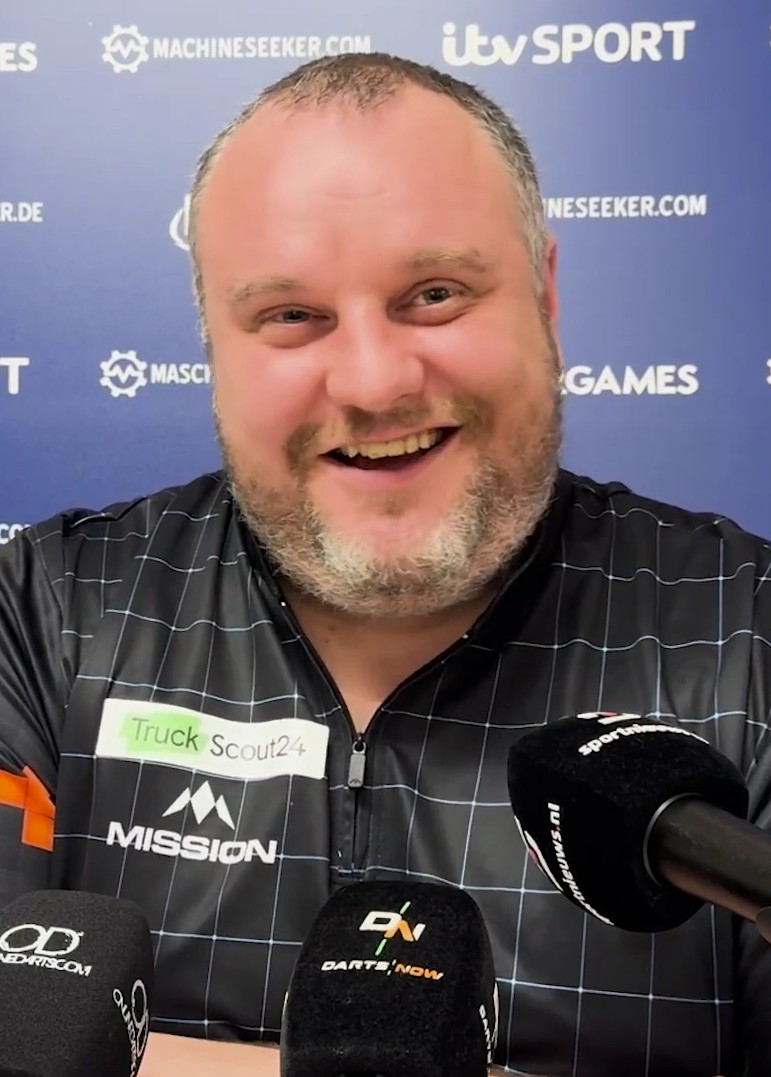
"It's great when you win like that. I would like to have played a little bit better, obviously. I think everybody probably thinks that," Joyce said in his post-match press conference, where DartsNews.com were present. "But at the end of the day, if you win, it feels great. You just want to concentrate on the next game."
Although the result might suggest otherwise, Joyce never felt the match was settled early. He had too much respect for Noppert's ability to relax. "Danny Noppert's an absolutely fantastic player. Sometimes it just takes one visit to say, 'Oh, that's what's happening. I've sorted it now,'" he explained. "If Danny had done that, he's an unbelievable player who could easily reel off five or six legs in a row. I was always under pressure throughout the whole game, knowing that such a talented player could easily come back at any time."
Joyce remained wary until the final double. "It's not the longest of formats. Even though there's an extra set to play, you still only need to win nine legs. It's not like a World Matchplay final or something like that," he said. "I always had that worry in the back of my mind that sooner or later Danny would get going, and then it would be a really tough battle."
Noppert appeared visibly troubled by something during the match, although Joyce said he had not noticed an issue himself. "No, I didn't notice anything at all. It didn't bother me at all." The pair shared a warm embrace afterwards. "All he said was, 'All the best for the rest of the tournament. I wish you the best of luck. Very well played. All the best in the quarters.'"
The doubles proved decisive, with Joyce taking almost every opportunity his Dutch opponent offered. "Timing is huge. I've lost lots of games where a player's taken a couple of big ton-plus finishes out of nowhere, and all of a sudden you've lost a couple of legs," he said. "You're thinking, 'I'm playing well. I shouldn't be losing.'"
Joyce felt the 3–0 scoreline was somewhat flattering. "Me and Danny didn't put on a brilliant performance today. We were both below par, but my finishing was really good and his wasn't. I think that's the difference," he explained. "The scoreline doesn't really reflect it. I didn't hammer him off the board. I didn't score brilliantly. I just took out all those doubles. I didn't really miss any chances that he gave me. That was the difference. Other than that, I feel like I need to improve for the next game."
His recent stage performances reflect a marked change in his career. For years, Joyce considered himself a floor specialist, but that assessment has been turned on its head. "I've played for 10 years now, and for maybe the first eight years I always thought of myself as a good floor player, really hard to beat on the floor. On the stage, I never really quite put it together," he said. "But since I started playing every Euro Tour in the last couple of years, it's flipped on its head."
His Players Championship results this year have been a different story. "I haven't even qualified for the Players Championship Finals. I'm nowhere near, actually," Joyce admitted. "I've been really poor on the floor, but on the stage, especially in the European Tours, I've felt like I've played really well. I feel much more comfortable on the stage now."
He is happy with that trade-off. "I think most players will say the same: you'd rather be good on the stage than good on the floor," he said. "The prize money is different, the prestige. Everything feels different when you win on the stage in front of all those people. I'm glad that it has flipped."
Simply getting to almost every European Tour event represents progress for Joyce, who spoke openly about his fear of flying a few years ago. "I did work on it. I still don't like it. Being stuck in the air on an aeroplane isn't my first choice of thing to do, but at the same time, it doesn't bother me like it used to," he explained. "It's much easier."
He has also noticed a wider improvement in his state of mind. "I've enjoyed playing in the European Tours over the last couple of years. I've found a way to enjoy it a lot more, and it really helps when you're in a better place mentally," Joyce said. "People don't realise that every single player on the tour is a fantastic player. They're all brilliant."
For Joyce, the mental side can make the difference in a field of talented players. "Being in a good mental state can separate you from being in the top 24 or not being in it, really," he said. "Everybody's talented. Everybody can do everything. But getting it right mentally is huge, I think. I feel like I've been in a much better place over the last couple of years than I have been in the past."
One of his methods is straightforward: turn negative thoughts into positive ones as quickly as possible. "It's something I've worked on, actually: only thinking positively. Whenever a negative thought creeps in, I try to flip it into a positive," Joyce explained. "It might work, it might not. The overall running average for the year might not suggest that it does anything at all. But in terms of the prize money won and the feeling I have, it feels better."
He is also conscious of making the most of his experience. "I'm not as young as I used to be. I'm probably closer to the end of my career than the start of it, so I'm going to try to make the next few years count as much as possible."
Joyce has even asked ChatGPT for advice on the mental side of his game, although the conversation began out of curiosity rather than a deliberate search for professional support. "I think I was just bored one night, and I thought, 'I'll put ChatGPT on and say, "I've got a big game coming up. Have you got any tips on how I can handle it better?"' Stuff like that," he recalled.
The response largely confirmed what he was already doing. "The AI programme gave me a list of lots of different things to do, and I thought to myself, 'Well, actually, I already do most of that. I already think like that.'" That recognition gave him some encouragement. "I thought, 'I've actually taught myself that from my own experience of being a professional for so many years.' That gave me a little boost," Joyce said. "I thought, 'I'll just continue with what I'm doing, then. I don't need anybody's help. I'm just going to do it myself.'"
Positive thinking is not always easy, however. Even against Noppert, Joyce walked off dissatisfied after winning the opening set. "In the very first leg, I missed three darts to get off, and then I did it again. I missed three darts twice to get off today, and that's the first time in the history of this tournament I've ever done that," he said. "It doesn't feel good."
Joyce questioned his own response afterwards. "Maybe I just needed to give myself a little boost and say, 'Come on, you're playing rubbish. You can do better,'" he reflected. "Maybe I shouldn't have reacted like that. When you're winning, you should take the positives, like I was saying before. It's hard to do that under pressure. Sometimes you think, 'This is not good enough.' It's a constant battle against your own brain, really."
The World Grand Prix remains an event that suits him particularly well. A semi-finalist two years ago, Joyce believes its format gives him his best opportunity to win a major. "It always has been. Probably always will be, until I lose my Tour Card or retire," he said when asked whether he targets the tournament. "I always try to win this major. I think it's the best chance I'll have to win one because starting on the doubles and finishing on the doubles is really good. It does play to my strengths as a darter."