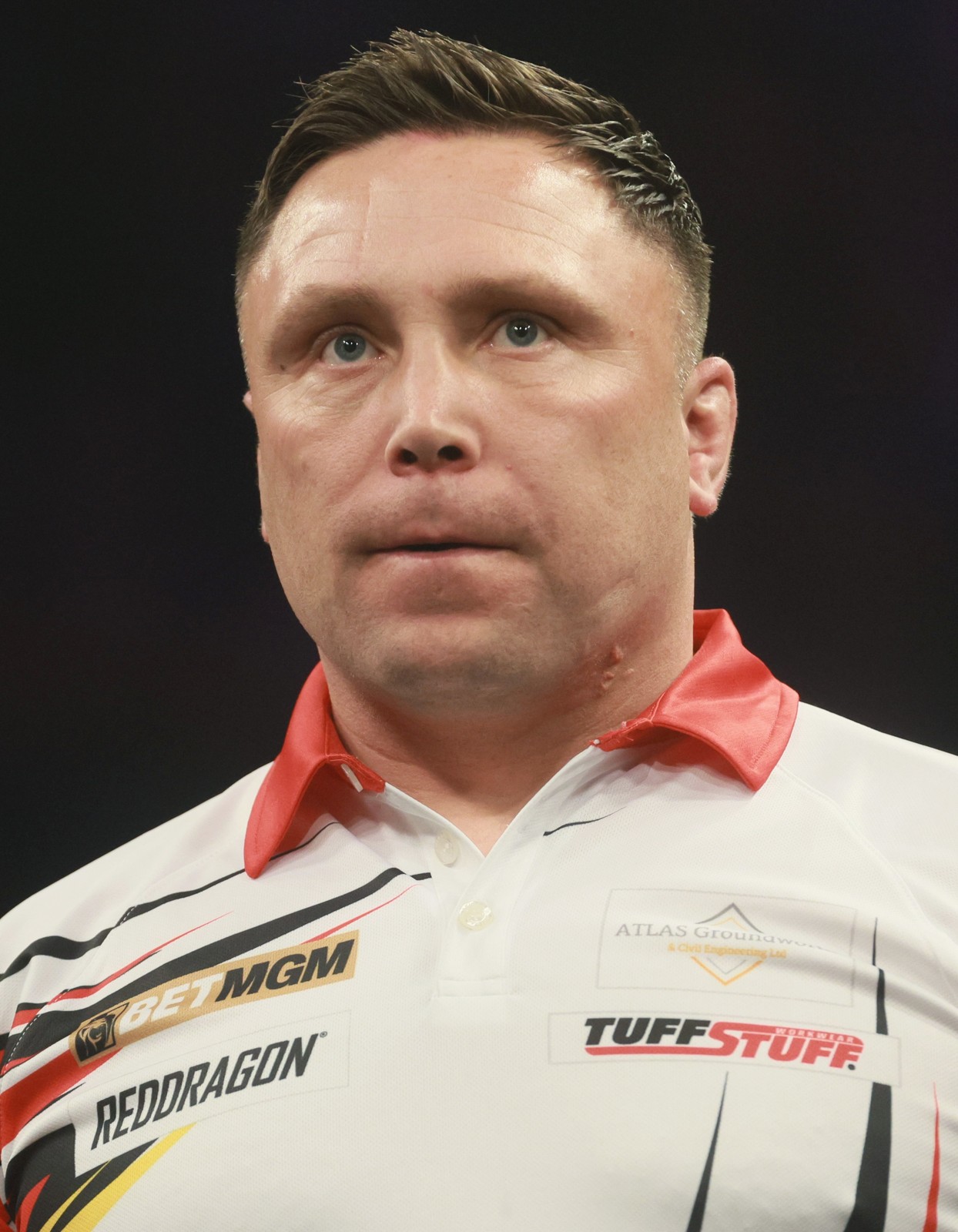
Gerwyn Price has made three major finals in 2026 and has only runner-up trophies to show for it. His last major title in the PDC was the 2021 Grand Slam of Darts, meaning if he doesn't win the European Championship later this month, he will enter a five-year drought without a major title. Yet, it feels different than this.
In the past three finals, Price had started well and dwindled, with the most obvious of these being last week's final against Humphries, where he led 3-0 in sets before losing to the 2024 World Champion 6-4. He clearly has the quality needed to win a title, and players have won majors in the past five years who were not, on any metric, better than Price. This year alone, he ranks third in highest overall averages and, in the last five years, has been in the top five averages three times, with his lowest being seventh. With Ritchie Edhouse, Mike De Decker, Andrew Gilding and other rogue names winning majors in the last five years, why hasn't Price? Is it unlucky, or has he hit form in the wrong era? If Gerwyn Price were in this form 10 years ago, would he be a 15-time major champion instead of just a seven-time champion?
Any era in darts is hard to compete in, but with the two Lukes, strong young coverage like Van Veen and a strong tour, it is harder than ever to win a major due to the competition. In 2015, the story had a similar title but different chapters. Michael Van Gerwen was at his peak, and Phil Taylor was in his twilight years, but still competitive nonetheless. From 2015-2017, Van Gerwen averaged 102.83 on TV and Taylor 99.91, with Glen Durrant closing the top five averages on TV with 97.20. This two-year period will be the era where Price can compare, because although he played in this competing era, most famously in the 2016 World Matchplay, where he lost to Adrian Lewis 11-5 in dramatic style, he wasn't the same player as the 2026 Price is. How many majors would Price win based on averages and checkout percentages?
Although there is no guarantee he would win any titles, especially with the five-year drought suggesting it is going far beyond high averages, it gives a good indication of whether Price could have picked up more majors. On the TV, Price has averaged 99.38, which in 2015-2017 puts him firmly as the fifth-highest average, with Anderson and Cross just above him but 0.32 and 0.09, respectively. With such minimal margins, Price is comfortably within the conversation of a major win in this time period. As Price has found out, averages don't win titles, but his composure and experience in this field could. In his prime, Michael Van Gerwen was just 3 years from his maiden major title at the 2012 World Grand Prix, and with the inexperienced Rob Cross, Glen Durrant, and an emerging Peter Wright in this field, Price would theoretically be in a good position to use his experience to beat his opponents.
Price's scoring power is his strongest attribute, and this isn't quite represented in 2017, ranking 6th in this list just behind Peter Wright. With Price hitting a first 9 average of 107.33 in 2026 and Wright hitting a 107.59 in 2015-2017, the usual names of Van Gerwen, Anderson and Taylor all outscore him. Although his experience may be used, his main attribute that carries such weight in modern-day darts can't be used in 2015-2017, again theoretically damaging his chances at a title but still putting him among the favourites for a title. Where Price succeeds in both eras is his checkout percentage, being third in both eras with a 43.3% checkout percentage. With all the stats to suggest he couldn't beat Van Gerwen or Taylor but had a favourable chance against any other player in the field, what majors could he have won?
2015–2017 TV Averages: Where Price Fits
Out of the 28 TV majors played from 2015-2017, Michael van Gerwen won 19 out of 28. This is dominance that goes beyond what Littler is doing and rivals the joint effort between Littler and Humphries to pick up major titles. With both Van Gerwen and Taylor both statistically outclassing Price, their 21 titles picked up leave just seven for Price. Anderson holds three of these titles, and with both of them statistically tied, meaning the 2026 Price, who seems to fold under the pressure of matched competition, seven becomes four: 2015 World Grand Prix, 2017 UK Open, 2017 World Grand Prix and the 2017 Champions League. With Gerwyn Price's positive record at the World Grand Prix following his final and his 2020 title, it is clear these are the opportunities to see whether Price would have this long of a drought in this era.
In 2015, Robert Thornton won the World Grand Prix in one of the best finals ever against Van Gerwen. Being outside the top 10 on any metric Price was named in the top 5 for, it is a fair argument to say Gerwyn Price had a strong chance, and theoretically, would have picked up the 2015 World Grand Prix. Similarly to the 2017 Grand Prix, Gurney was not in these top 10s Price appeared in, and although he was immense in 2017, he was inexperienced, and under the pressure of a Price rather than a Simon Whitlock in a final, the Welshman could be a three-time World Grand Prix champion. Mensur Sulijovic would have faced the same fate in the 2017 Champions League, with him only appearing in the top 10 checkout percentages during this era.
Overall, this shows that in the 2015-2017 era, Price could have won three major titles and could be a 10-time major champion. Yet, this is built on "if" variables. If he faced Gurney, if he faced Thornton, but when was it that he lost to Tricole in the 2024 Players Championship final and to Welsey Plasier in last year's World Championship? The foundations of these theories prove that Price isn't in the wrong era, but there's a fundamental block to him winning these titles. He should have beaten Smith in Amsterdam in September, and in the position he was in against Humphries, he should be a two-time major winner in 2026. But factors that stats can't account for influenced his performance, and he isn't. So what has happened?
Gerwyn Price has not won a major title for over four years
Since his 2021 Grand Slam title, Price has seen players ranked significantly lower than him in the rankings pick up titles. Most recognisably, Edhouse's 2024 European Championship win and Gilding's 2023 UK Open. Price has also watched players like Noppert, De Decker, Cullen, Bunting and Dobey win a major title. This is the most damning evidence that averages don't win titles, but composure does.
Price is the second-best player in terms of averages in this five-year drought, and especially in the last 2 years, he has consistently averaged above 98. Hitting 99.17 in the first six months of 2026, there's no doubt the Iceman has the pieces, but putting the jigsaw together hasn't clicked. What's most confusing to the naked eye is the lack of movement and consistency in these numbers over two years. The range is consistently minimal, with the first nine less than a point and checkout percentage fluctuating from 41–44%. Explicitly, this consistency breeds these long runs, but with these numbers, Price will feel a huge weight on his shoulders, feeling at one point that something has to give, and that something is a title. This flatness explains his title drought. He reaches the latter stages of the tournament, and when the rest of the field finds the extra gear, as seen with Humphries reeling off 6 sets of the final 7 in last week's final and Smith finding 6 consecutive legs in the World Series of Darts finals, Price plateaus.
Price's Metric Flatness 2025-2026
Averaging 98 would win a title in theory, but in finals, Price keeps dropping off. Using last week's final as an example, Price averaged 109.84 in the first three sets in World Grand Prix format, which would be in a standard match heading north of 115+. This outburst of that last gear then bites Price and almost obliges him to drop his standard to his flat rate of 98, or in this match, the final 7 sets averaging 91.47. This would be around his 98 average in a standard game, but this shows that in the context of a major final, Price no longer suits them. Humphries hit back after going 3-0 down with 3 sets averaging 100+, and Price had no response. Against good competition that outscores him and outdoubles him, he struggles to pick himself back up and go again.
Ross Smith ran him ragged in the last 6 legs of the World Series of Darts finals, with a hat-trick of broken throws putting Price through mental torture. This showed a weakness of Price, where he submitted to defeat; throwing darts away and not putting on adequate pressure to influence the outcome of his opponent's darts, he pretty much handed Smith the World Series of Darts trophy. Off TV, he has won six PDC titles because the format suits him. He can go into overdrive for 8 legs and beat opponents 6-2. When it comes to long-format games, he plateaus at his 98 average and in the most competitive era of darts, opponents will comfortably reel off 15 dart legs to beat him.
The clearest obstacle is Luke Littler. At nineteen, Littler is doing something that even Van Gerwen's peak did not quite replicate in terms of trajectory, and Price has had the misfortune of standing directly in front of it on multiple occasions in 2026. The World Matchplay final is the most obvious example. Price was three sets up, averaging above 109, playing some of the best darts of his career. Littler won the next six. That sequence did not expose a weakness in Price so much as it illustrated the scale of what Littler is currently doing to every player in the field. Peter Wright would not have come back from that. Neither would Michael Smith. The problem for Price is that he keeps drawing the one player capable of producing that kind of response.
What makes that particularly costly is the timing. Price is forty-one, in the form of his career by most measurable standards, and the window for converting that form into titles is not indefinitely open. Littler is not going anywhere, Humphries continues to grow, and the margins in major finals are too fine to absorb repeated near-misses. Every final Price loses to one of them is a final he cannot reclaim, and the weight of that accumulates in ways that statistics do not capture, but players absolutely feel.
Read also
"I'm not bothered...I am bothered": Gerwyn Price quickly changes tune on another major disappointment at World Grand Prix
PDC Order of Merit Update after World Grand Prix: Champion Luke Humphries creates World No.2 gap as James Wade returns to top five
Amsterdam is the more honest mirror. Ross Smith did not outplay Price across the board. He won six consecutive legs at the end, and Price stopped competing rather than forcing him to earn it. That is a different problem from the one Humphries and Littler exposed, and it matters because it sits outside anything an era comparison can explain. Averages and checkout percentages cannot account for the moment a player decides the match is over before it is.
The European Championship later this month is the clearest test of where Price actually stands. If Littler and Humphries land in the opposite half of the draw, his numbers are good enough to win it. They have been good enough for most of this year. Whether he is in the wrong era or simply carrying a block that statistics were never going to identify, the answer will not come from the data. It will come from what he does when the draw gives him the chance he keeps insisting he deserves.