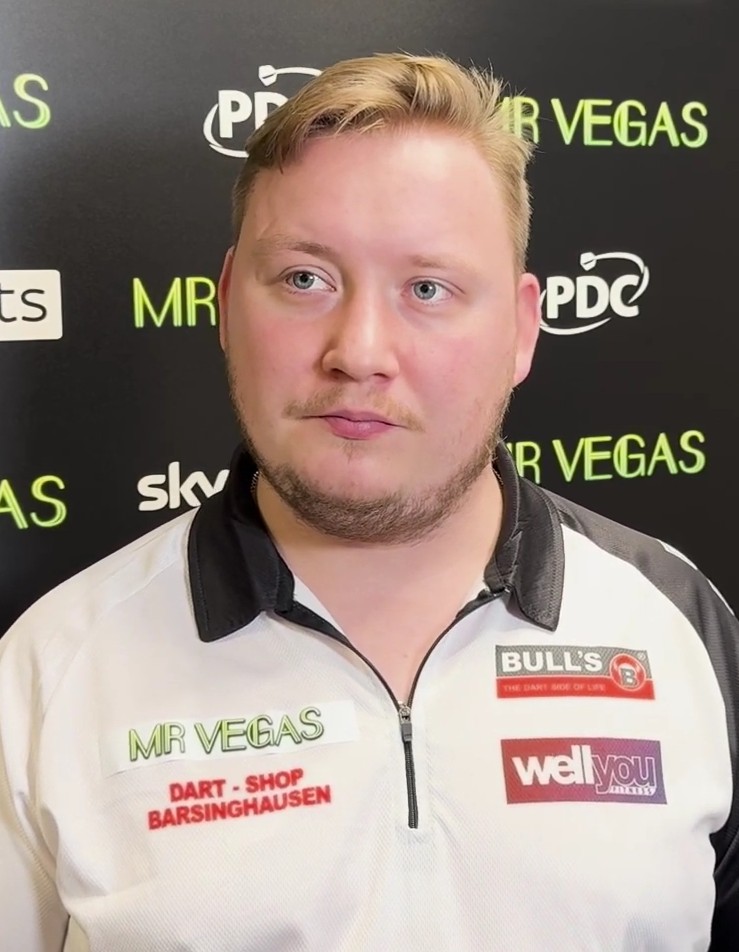
Martin Schindler has reached the last 16 of the Grand Slam of Darts, but it was his interview after beating Chris Dobey that drew the most attention. Germany's No. 1 continued his strong form with the win, then spoke at length about his mental health, the thoughts that race through his mind during matches, and why he suspects he has ADHD.
Schindler has been one of Germany's top darts players for some time, but he also endured a spell this season when his results dipped. He has since rediscovered his form, yet the German is still looking for ways to improve on stage. In his view, it is not just about his throw or scoring power — what goes on in his mind matters most. Asked whether he had considered working with a mental coach during his difficult spell midway through the season, his answer was striking. "I don't know if a thing like that is a thing a mental coach can handle on its own. I think this is way more deep than a mental coach can give you. I think what I have in my situation is probably something for a therapist or something because it's crazy, honestly," said Schindler. "I'm pretty sure, I don't have a diagnosis in my life because I never went to a doctor, but I'm pretty certain I have ADHD. So, I'm here. My head goes running. Luckily for me, I'm talking about an interesting topic for me, so I'm very focused on this interview right now."
The German sees a clear difference between the support a mental coach provides and the help he may need himself. "But yeah, so I think for me, it's probably, in my kind of situation, it would be more of a therapist thing than a mental coach thing because with a mental coach, it's more about how you deal with the situations. Like, your opponent has a good moment or I have a weak moment, how you can get back from that? How you can reset it? And also, stay focused always on your rhythm and everything."
Although Schindler is known away from the stage as a friendly, cheerful person, he usually shows a very different side during matches. The 30-year-old almost always looks serious and focused, and he admits that this may not be the best way to handle the pressure of a match. "I think it's a big part of my personality which is missing on stage. I think I can smile a lot more when I'm up there. Like, I'm the funniest guy on earth! That's not what I mean. But I have a lot of humour in me. I don't always take things too seriously. But, up on stage, I'm always like this focused guy." He believes a more relaxed approach could actually help him perform better. "I think sometimes when you laugh a little bit about things that are happening, maybe they're darting-wise kind of funny, then you're getting a little bit more relaxed. Then maybe you get your focus back. Maybe you're not so tense at all. I think this part of my personality was missing for a couple of years now."
That does not mean Schindler is deliberately trying to act differently on stage. He wants to look as calm and focused as possible, even when his thoughts are all over the place. "I always try to look as cool as a cucumber. I always try to look as cool as I can and also to look as focused as I can, to be especially in it. But honestly, when I'm up there, my head just goes running. I'm there, but my head is probably behind Row 30, if you know what I mean." Asked what goes through his mind during matches, Schindler did not need long to answer. "Everything. Honestly, everything. Why was he now throwing 140 when the first dart was like three centimetres above the treble? Or something like, I don't know, why was my visit only 41 because it felt better than I could do. So I don't know how to say it. It's just my head is talking to me a lot in the game."
Schindler tries to focus on the present as much as possible, but finds that it is not always easy. That is exactly why he thinks he needs to dare to be a little more himself on stage. "I try as best as I can to be in the moment, to focus on the game. Also, I think I just need to be a little bit more of me, because I said it a bit earlier. I think I need it sometimes." He does not want to swing too far in the other direction, either. "Obviously, I cannot go up there and smile all the time like some other players. I don't like that. But I think sometimes when there's a funny situation, I think that's when you have to smile."
Despite the nerves he experiences during matches, Schindler was pleased with his performance in the group stage of the Grand Slam of Darts. He believes his focus and positive body language played a key role in reaching the knockout stage. Away from the oche, the German tries to put as much distance as possible between himself and the sport, believing it is important to keep his professional career and family life separate — although that is not always easy in practice. He shared a revealing anecdote about how his home is arranged. "Funny private story. When I was talking to my wife in the last couple of years, we moved a couple of times because obviously things have changed. We got a child, so we needed to move to bigger places and everything and I said to her: No dartboard in the living room." That plan has since fallen through. "So the dartboard has to be at the furthest place away when I'm at home. Unfortunately, right now, the dartboard is in the living room!"
According to Schindler, it all comes down to his desire not to be constantly reminded of work at home. "I don't like it in a way that, when I'm in private, when I'm with my wife, when I'm with my children or with my child, then it's private. I don't want to really think about darts." At the same time, he knows he can never leave the sport completely at the door. "Obviously, it's going to happen because this is my life. And with sponsors, exhibitions, other events, you have to talk about certain things. That's just the way it is." Still, he tries to keep those commitments as separate as possible from family life. "But I always try to keep darts out of my private life as much as I can, if that makes sense."
By qualifying for the last 16 of the Grand Slam of Darts, Schindler has taken another step forward on the sporting front. At the same time, his candid account shows that the German is still looking to improve away from his performances at the oche. Finding greater peace of mind and enjoying the stage more again seem to be important priorities for him.